Friday, 28 October 2011

WEEK 13: MR. TOASTER!?

I'm sure we all remember this video that we were shown during this weeks lecture: 


It's pretty scary thinking that one day your appliance can communicate with you. It's even scarier thinking that one of the implications of this would be emotional attachment. Now, imagine your toaster as your pet, your companion. You will name it, communicate with it and eventually bid it goodbye. 


This is a perfect example of what I think the future holds: 


The toaster is fully functional with it's own organs and bodily parts (computer and wires). The point I'm trying to make is that technology is becoming more humanised in terms of design and function. 


Now imagine that others can monitor the progress of your toaster on websites such as Talesofthings.com. So what would happen if one unfortunate day your toaster friend is no more? How you think this would impact you and the followers of your toaster? 


I personally think within minutes of your toasters passing there would be facebook pages, blogs and Youtube (this is assuming your toaster would be quite popular). 


I know I sound quite extreme in what I'm saying, but this is what I think the future is headed for in terms of technology. 


What do you think? 


Reference:


Talesofthings.com, 2011, 'It's a memory thing', Accessed 28th October 2011, http://www.talesofthings.com/


Image sourced from: http://walyou.com/wp-content/uploads/2010/08/HotToastNightmare_by_Madspeitersen2.jpg

WEEK 12: NOKIA THE WAY OF THE FUTURE

No, not really...

As much as I love my NOKIA E-something, I would really love to update to another, perhaps a smart phone.


This is my phone currently. It's doesn't have a touch screen, it is not ergonomical and worst of all it has BUTTONS.
(This is not an actual photo of MY phone, the buttons on my phone have actually fallen off. However, this photo clearly shows how non-functional my phone is.)

It looks horrible right? I'm not trying to diss Nokia or this particular model, but lets face it this is no smart phone.

I personally find Android and iPhone applications/ functions to be amazing. I have experienced both iPhone and Android applications, and I have found that I currently prefer Apple applications. This is only because at the moment there are so many applications available for Apple, but in saying that it is only for now. Android is another platform which is growing with applications, most of which that are conversions of Apple applications. As I said earlier, I currently prefer Applications but I can see myself moving onto Android applications as I am sure that they will become advance and innovative as new applications are developed. 

I think Android will one day take over Apple. I believe this is due to the limitations Apple already faces, which is itself. Apple can only create applications for Apple, perhaps if they had compatible applications for other smart phones they would not suffer later. Apple is limited by Apple! 


Image sources from: ttp:https://blogger.googleusercontent.com/img/b/R29vZ2xl/AVvXsEjKej4a7AJ2VLQlVwoWEfIg_zBoZMfL1WHlVmGAdZD5ICoYdpMvYqRTks6Y-siJL75gdxfrIoLri4d-jwqsq6YXT1blba8eY6Z9zIiaivz9Cqz9OOrwWhhxuzuMqs4RgeDzYk3QeW-1gwZX/s400/mynokiae71.jpg

Wednesday, 26 October 2011

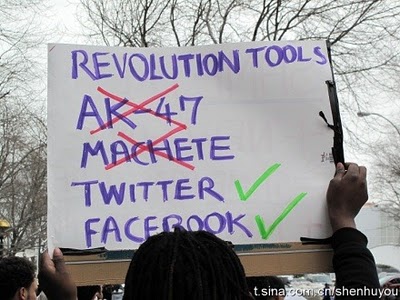
WEEK 11: ARE TWITTER AND FACEBOOK WHERE REVOLUTIONARIES GO?


ARE TWITTER AND FACEBOOK WHERE REVOLUTIONARIES GO?


I think so, I believe that social media is an effective way for activists to broadcast and endorse their protest. However, social media is not the ONLY platform for protest. There are different tools available for sharing news globally and discussion. Social media is effective as it simply enables news to travel faster, there is many-to-many communication in which a larger audience is targeted and thus creating a larger basis for protest. Basically, what is a protest without protesters (even if that means they are online). If you consider recent international news, for example the death of Muammar Gaddafi, there facebook pages dedicated to the support for Gaddafi . Through this it is evident the level of power the media has, especially social media in which society is able to interact on matters of the world.


In the article "Facebook and Twitter are just places revolutionaries go" Morozov (2011) argues that social platforms such as Twitter and Facebook are not the main reason for revolutions. However, I believe it is not as extreme, social media is but a mere catalyst for protest. Online activism uses social media as a tool for protest rather than the means for protest. There are many other ways to protest online, for example video hosting websites such as Youtube. Again, protest videos from Youtube are taken and shared through Twitter and Facebook. This further supports the fact that there are other forms of media that support protest and activsm.


Reference:


The Guardian, 2011, Facebook and Twitter are just places revolutionaries go, accessed 19/9/2011,http://www.guardian.co.uk/commentisfree/2011/mar/07/facebook-twitter-revolutionaries-cyber-utopian


Image sources from: http://www.freedomsphoenix.com/Uploads/Graphics/387-0307203921-egypt-twitter-facebook-revolution.jpg

Sunday, 23 October 2011

WEEK 9: ARE YOU A HACKER OR AN ACTIVIST?

We've heard of activism, but what exactly is online activism? Well, it is still protesting but with your computer. Online activism is described as "a means by which advanced information and communication technologies...are used by individuals and groups to communicate with large audiences, galvanizing individuals around a specific issue or set of issues in an attempt to build solidarity towards meaningful collective actions" (Networkedpublics, 2006).Hacktivism on the other hand is defined as "Hacktivism is the fusion of hacking and activism; politics and technology. More specifically, hacktivism is described as hacking for a political cause” (The Hactivist, 2009).


I have recently come across many issues surrounding the media in terms of hactivism and activism, some of the most popular being Nestle vs. Greenpeace and activities of the hackers called Anonymous and of course Wiki leaks. I am not going to simply distinguish between hactivism and activism, but I want to focus on the opportunity that we as individuals have in this day and age. It amazes me that through the use of media one can either protest or dispute by hacking. 


Why can't one simply protest without hacking? Is it because it is not as effective? I actually believe so, activism is out in the open for everyone to see which also means protesters too are seen by the public. Hacking, however, is unseen by the public until the damage is already done or when the organisation is warned. The point I'm making here is, is it easier to be a hacker from your bedroom rather than being an activist and openly fighting for your cause? I think hacking is the way of the future, pretty soon people will start to hack Apple on the latest iPhone. 


If you had the knowledge, time and desire for information would you become a hactivist or activist? 


References: 


Netwrokedpublics. 2006, 'Cyberactivism', accessed 9/10/11, http://networkedpublics.org/cyberactivism


The Hacktivist, 2009, 'What Is Hactivism?', accessed 6/10/11, http://www.thehacktivist.com/

Sunday, 18 September 2011

WEEK 8: GATEKEEPING, GATEWATCHING & the PROSUMER.

Citizen journalism is a shift from traditional media consumption and content production. Bruns (2009) states that "journalistic content is being overtaken by a flotilla of alternative options". This means that the role of journalism is constantly changing. I believe this is due to the advancements in technology which have now enabled users to become prosumers. This makes information accessible anywhere at anytime.

 In the past gatekeeping was in place to filter information according to what sold. However, now we have gatewatching, Bruns (2009, pg. 5) describes gatekeeping as "first-hand investigative research and the ability to compose succinct news stories". This means that gatewatchers search for "useful and relevant materials that they think should be brought to the attention of the wider community" (Bruns, A, 2009, pg. 6). This is not as extreme as gatekeeping where information "about potentially newsworthy events entered the process" (Bruns, A, 2006, pg. 3). This means that information was selected due to its worthiness of getting attention and gaining capital.

Our information content is hardly controlled in my opinion, people post whatever they want whenever. What are the implications of these? We are flooded with irrelevant information everyday. This also means that we’re sometimes given information that we believe originated from a legitimate source it actually it has been distorted and altered many times before publication. I think when you think about the processes that some content goes through, it is really hard to determine its originality. I think content gathered from citizen journalists are at times untrue and questionable in terms of originality.

I guess it is up to us as producers and consumers of information to decide what information is valid and what is not.


Reference:


Bruns, A. (2009) 'News Blogs and Citizen Journalism: New Directions for e-Journalism' [URL: http://produsage.org/files/News%20Blogs%20and%20Citizen%20Journalism.pdf]

Sunday, 11 September 2011

WEEK 7: NEXT 100 YEARS TO SEE THE EXINCTION OF MALLS?

I had never noticed the trend of businesses shutting down due to the invasion of the market by online stores that offer much more in stock and variety than what a physical store is capable of holding. We were given the example of Amazon VS. Borders book store, however, this is not only applicable to book stores but also music, clothing and even grocery stores. Do we really borther to buy actual cd's anymore or do we just download from iTunes?

This youtube video highlights Amazon and it's benefits of selling books online. The video clearly states that there is a completely different business model as the purchase is no longer tangible, it is done online. Does this also mean an end to Woolworths, Officeworks, Big W and other stores that sell the basics. We are able to order anything and everything online. In the next hundred years do you think we would even have a physical market place anymore?

I'm not too sure, I personally think we would be heading towards a shift in online shopping and physical market places would become exitinct. Do you think this would be an implication of our technology?


Reference:
nan0801, 2011, Amazon VS Local bookstore, accessed 10/09/2011 http://www.youtube.com/watch?v=BfTGcqQquIw

Thursday, 8 September 2011

WEEK 6: I AM NO LONGER AFRAID OF COCKROACHES.. because I have friends.


Disregard the title, I saw it in the lecture and found it too funny.


Convergence led me to not being afraid of cockroaches any more. I believe convergence has such an exceptional role today with the use of new media (which is in some aspects convergent media).


This Youtube video outlines just how important convergence is. It explores the digitization and convergence of basic items such as newspapers, books and magazines. Basically print media is no longer print - it's online.

It is evident now that platforms have changed and so has the content. Audiences are no longer passive, but active prosumers (producer/ consumer). Without convergence do you think this would be possible? I would not think so. Gotta love convergence. Jenkins (2006, pg. 3) states that 'the circulation of media content depends heavily on consumers' active participation'. The link I shared above of the Britney Spears parody, it is a perfect example of how Youtube is circulating with consumers active participation. Imagine Youtube without user generated content, it would defeat the purpose of its' existence right? Again, Jenkins (2006, pg. 17) also mentions that convergence "occurs when people take the media into their own hands".

I think it is so amazing that us as audiences or 'produsers' keep media platforms such as YouTube alive. It gives us as audiences such importance in the evolution of new media and other technologies and their capabilities.


Reference:


Jenkins, H 2006,'Worship at the alter of convergence: A new paradigm for understanding media change', Convergence Culture: When old media and new media collide, pp 1-24, New York, New York University Press


VenetianPrincess, 2010, "Britney Spears - I Wanna Go - Parody ("I Gotta Go")" YouTube, accessed 8/9/2011, http://www.youtube.com/watch?v=q40DDjIKOmY&feature=related


xplanevisualthinking, 2009, "Did You Know 4.0", YouTube, accessed 8/9/2011, http://www.youtube.com/watch?v=6ILQrUrEWe8


Friday, 26 August 2011

WEEK 5: DISNEY - Genius or piracy?


A world without copyright, can you imagine that?


Well, lets face it, we are all criminals. I'm sure we have all accessed files illegally at least once in our lives.

I never knew (until the lecture) the publishing industry bloomed through piracy. It just amazes me to see that there have been such significant changes since the implementation of copyright laws.


I also wonder if some of the famous academics we recognize today are actually not what we make them out to be. Maybe they have stolen someone else's work and claimed it as their own. As an example of this idea Lawrence Lessig (2004) argues that Walt Disney's creativity was "built upon the works of others".


To think that a little part of our childhood was derived from someone else's 'genius' really makes me question of all the other content that we have ever been exposed to.


I'm really hoping Aladdin wasn't stolen or derived from someone else.


Piracy really makes me question whether the content we access these days are actually original or just a stolen copy of someone else's work.

Do you think you can trust all the sources you come across? Do you believe it to be the original source?


Lessig, L. (2004). Creators. In Free Culture: How Big Media uses Technology and the Law to Lock Down Culture and Strangle Creativity (pp. 21-30). New York: Penguin, URL: http://www.authorama.com/free-culture-4.html

Wednesday, 17 August 2011

WEEK 4: FACEBOOK at work? YES PLEASE.. WORK at the beach? NO THANKS

I think we have all found ourselves in a position where we are out with friends having dinner and find ourselves switching back and forth from Facebook or Twitter. I did not know that this habit could be defined in a term, that is, presence bleed.


We have evolved from liquid labour to presence bleed. Technology is so evolved that we have it at our dinning table, but let's face it, how many of us actually sit at the dinner table and don't give any attention to our phone? It's not about what information we access, it's actually about where and how we access it. 


The reading by Bradwell & Reeves explores organisational thinking in terms of social media. Bradwell and Reeves (2008) note that "more manually intensive employment has moved out" and evidently workers are now dependent on technology to complete the days tasks. With the evolution of technology it now means that a one can simply work from home. But does this not evade the total concept of leisure?  Isn't home our sanctuary, where we not need any stress or tension? We don't have to be at work to engage in work, we can be at home or even at the beach like this guy:


Hang on! Would we not then be blurring the lines between leisure and work

Well, yes we would. But I believe that it is now becoming more and more evident to not just employees but employers too that there is now an overlapping of both work and leisure. 


Bradwell and Reeves (2008) also discuss the way in which that some business have "begun to embrace the way social networks work". Bradwell and Reeves (2008) also mention that now employers are offering values that "match those of potential employees".  Does this mean that employers are now going to allow their employees to access Facebook or twitter through their work computer at any given time of the day? or even more extraordinary, that is, working from home?


Bradwell, P., and Reeves, R. (2008) Economies. In Networked Citizens (pp. 25-31). London: Demos. Accessed 18th August, 2011, http://www.demos.co.uk/files/Network%20citizens%20-%20web.pdf


Image sourced from: http://thevecciblog.files.wordpress.com

Thursday, 11 August 2011

WEEK 3: CYBERSPACE; an act of nature

In the reading by Barlow (1996) lead me to consider our internet usage. Barlow (1996) explores issues concerning the sharing of information in cyberspace. 


Barlow (1996) defines Cyberspace as '...an act of nature that grows itself through our collective actions'. I believe this to be true, it is so evident even now after 15 years. The internet has become such a large platform for expression and sharing of information. It is larger than ever with consistent activity and information flow. I believe most of the information shared on the internet comes from "our collective efforts", that is sharing information through platforms such as Facebook pages, Youtube, blog posts, comments, Tweets and other uploads.


Barlow (1996) also states in the reading that online we have no 'elected government or greater authority'. I find this statement to be true to an extent, for example at the moment users are provided with options for reporting and blocking content. In this sense we are our own allocated authority. However, this statement is also untrue in the sense that we also have constant online monitoring and regulation of information and websites by authorities. 

I believe online information is freely shared to an extent as well. However,  there are still underlying issues such as plagiarism and piracy that concern sharing of content. As user of the internet I also believe that it is our "collective efforts" that make the internet so plentiful in information and it is only natural that is grows.


Barlow, JP 1996, 'A Declaration of the independence of Cyberspace', https://projects.eff.org/~barlow/Declaration-Final.html, Accessed 11/8/11

Friday, 5 August 2011

WEEK 2: THE FINELINES AND IMPLICATIONS OF VIRTUAL REALITY

In the lecture this week we spoke about the influence of the invention of the telegraph on other technologies and inventions. I however was more interested by this week’s reading by Lawrence Lessig, “Four puzzles from cyber space”. In the reading Lessig (2006) discusses cyberspace and the fine lines between it and reality.


There are a number of stories or scenarios given in the reading. Some describe situations where neighbours are fighting over land, ‘deadly flowers and dogs that can easily be replaced’ (Lessig, L 2006, pg. 10). Before reaching the midsection of the scenario I had realised that it was not something that had taken place in real life. This was a scenario taken from an MMOG or “massively multiplayer online game” (Lessig, L 2006, pg. 9). 


Lessig (2006) further draws on the borders and fine lines between reality itself and virtual reality. He states that “virtual spaces let the user control the characters on screen in real time” (Lessig, L 2006, pg. 11). When you think about factors such as real time and effort being dedicated for an online accomplishment it may not make really any sense.  However, I believe that other factors such as real life characteristics within the game truly engage the player i.e., being able to build a house, garden, have pets and most of all alter your physical appearance.


To further support my blog I wanted to share a video that I originally saw on Today Tonight – 4/8/2011. I have sourced it from the Today Tonight website, the video shows some of the implications of online gaming on teenagers. The video discusses they way in which the young gamer: 

  • Quit her job
  • Stopped seeing friends
  • Stopped going to school 
  • Would not eat or sleep


Lessig, L 2006, "Four puzzles from cyber space”, Code version 2.0, New York
Today Tonight, 2011, Television program, Australian Broadcasting Corporation, Sydney, 4th August.


WEEK 1: WHO AM I?!

Oh hai. 

 Who am I you ask? 

Well... My name is Varsha, I'm 20 years old soon to be 21 in October (YAY). I am Fijian-Indian, I was born in Fiji and moved to Australia when I was 9 years old. I am currently studying a BA in Media and Communications with a major in Advertising and marketing. It is my final semester, hopefully. I LOVE baking (especially cupcakes, YUM), travelling, sleeping (come on who doesn't love sleep?) and I LOVE my family and friends

I don't have many hates..


My experience of massively multi player online games would be on sites such as IMVU  and Second Life. I however prefer the Sims over online mutli player gaming - it's funner that way. :) 


The end.