Friday, 28 October 2011

WEEK 13: MR. TOASTER!?

I'm sure we all remember this video that we were shown during this weeks lecture: 


It's pretty scary thinking that one day your appliance can communicate with you. It's even scarier thinking that one of the implications of this would be emotional attachment. Now, imagine your toaster as your pet, your companion. You will name it, communicate with it and eventually bid it goodbye. 


This is a perfect example of what I think the future holds: 


The toaster is fully functional with it's own organs and bodily parts (computer and wires). The point I'm trying to make is that technology is becoming more humanised in terms of design and function. 


Now imagine that others can monitor the progress of your toaster on websites such as Talesofthings.com. So what would happen if one unfortunate day your toaster friend is no more? How you think this would impact you and the followers of your toaster? 


I personally think within minutes of your toasters passing there would be facebook pages, blogs and Youtube (this is assuming your toaster would be quite popular). 


I know I sound quite extreme in what I'm saying, but this is what I think the future is headed for in terms of technology. 


What do you think? 


Reference:


Talesofthings.com, 2011, 'It's a memory thing', Accessed 28th October 2011, http://www.talesofthings.com/


Image sourced from: http://walyou.com/wp-content/uploads/2010/08/HotToastNightmare_by_Madspeitersen2.jpg

WEEK 12: NOKIA THE WAY OF THE FUTURE

No, not really...

As much as I love my NOKIA E-something, I would really love to update to another, perhaps a smart phone.


This is my phone currently. It's doesn't have a touch screen, it is not ergonomical and worst of all it has BUTTONS.
(This is not an actual photo of MY phone, the buttons on my phone have actually fallen off. However, this photo clearly shows how non-functional my phone is.)

It looks horrible right? I'm not trying to diss Nokia or this particular model, but lets face it this is no smart phone.

I personally find Android and iPhone applications/ functions to be amazing. I have experienced both iPhone and Android applications, and I have found that I currently prefer Apple applications. This is only because at the moment there are so many applications available for Apple, but in saying that it is only for now. Android is another platform which is growing with applications, most of which that are conversions of Apple applications. As I said earlier, I currently prefer Applications but I can see myself moving onto Android applications as I am sure that they will become advance and innovative as new applications are developed. 

I think Android will one day take over Apple. I believe this is due to the limitations Apple already faces, which is itself. Apple can only create applications for Apple, perhaps if they had compatible applications for other smart phones they would not suffer later. Apple is limited by Apple! 


Image sources from: ttp:https://blogger.googleusercontent.com/img/b/R29vZ2xl/AVvXsEjKej4a7AJ2VLQlVwoWEfIg_zBoZMfL1WHlVmGAdZD5ICoYdpMvYqRTks6Y-siJL75gdxfrIoLri4d-jwqsq6YXT1blba8eY6Z9zIiaivz9Cqz9OOrwWhhxuzuMqs4RgeDzYk3QeW-1gwZX/s400/mynokiae71.jpg

Wednesday, 26 October 2011

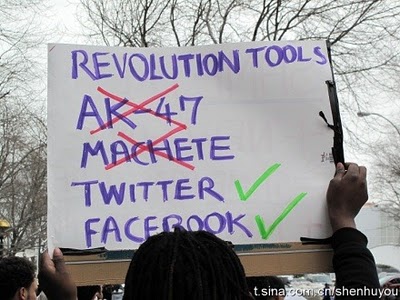
WEEK 11: ARE TWITTER AND FACEBOOK WHERE REVOLUTIONARIES GO?


ARE TWITTER AND FACEBOOK WHERE REVOLUTIONARIES GO?


I think so, I believe that social media is an effective way for activists to broadcast and endorse their protest. However, social media is not the ONLY platform for protest. There are different tools available for sharing news globally and discussion. Social media is effective as it simply enables news to travel faster, there is many-to-many communication in which a larger audience is targeted and thus creating a larger basis for protest. Basically, what is a protest without protesters (even if that means they are online). If you consider recent international news, for example the death of Muammar Gaddafi, there facebook pages dedicated to the support for Gaddafi . Through this it is evident the level of power the media has, especially social media in which society is able to interact on matters of the world.


In the article "Facebook and Twitter are just places revolutionaries go" Morozov (2011) argues that social platforms such as Twitter and Facebook are not the main reason for revolutions. However, I believe it is not as extreme, social media is but a mere catalyst for protest. Online activism uses social media as a tool for protest rather than the means for protest. There are many other ways to protest online, for example video hosting websites such as Youtube. Again, protest videos from Youtube are taken and shared through Twitter and Facebook. This further supports the fact that there are other forms of media that support protest and activsm.


Reference:


The Guardian, 2011, Facebook and Twitter are just places revolutionaries go, accessed 19/9/2011,http://www.guardian.co.uk/commentisfree/2011/mar/07/facebook-twitter-revolutionaries-cyber-utopian


Image sources from: http://www.freedomsphoenix.com/Uploads/Graphics/387-0307203921-egypt-twitter-facebook-revolution.jpg

Sunday, 23 October 2011

WEEK 9: ARE YOU A HACKER OR AN ACTIVIST?

We've heard of activism, but what exactly is online activism? Well, it is still protesting but with your computer. Online activism is described as "a means by which advanced information and communication technologies...are used by individuals and groups to communicate with large audiences, galvanizing individuals around a specific issue or set of issues in an attempt to build solidarity towards meaningful collective actions" (Networkedpublics, 2006).Hacktivism on the other hand is defined as "Hacktivism is the fusion of hacking and activism; politics and technology. More specifically, hacktivism is described as hacking for a political cause” (The Hactivist, 2009).


I have recently come across many issues surrounding the media in terms of hactivism and activism, some of the most popular being Nestle vs. Greenpeace and activities of the hackers called Anonymous and of course Wiki leaks. I am not going to simply distinguish between hactivism and activism, but I want to focus on the opportunity that we as individuals have in this day and age. It amazes me that through the use of media one can either protest or dispute by hacking. 


Why can't one simply protest without hacking? Is it because it is not as effective? I actually believe so, activism is out in the open for everyone to see which also means protesters too are seen by the public. Hacking, however, is unseen by the public until the damage is already done or when the organisation is warned. The point I'm making here is, is it easier to be a hacker from your bedroom rather than being an activist and openly fighting for your cause? I think hacking is the way of the future, pretty soon people will start to hack Apple on the latest iPhone. 


If you had the knowledge, time and desire for information would you become a hactivist or activist? 


References: 


Netwrokedpublics. 2006, 'Cyberactivism', accessed 9/10/11, http://networkedpublics.org/cyberactivism


The Hacktivist, 2009, 'What Is Hactivism?', accessed 6/10/11, http://www.thehacktivist.com/